Optical Depth Interpolation
This notebooko demonstrates the basic use of the optical depth class and how to load a model included in the package
[1]:
%matplotlib inline
Imports
[2]:
import matplotlib.pyplot as plt
import numpy as np
from ebltable.tau_from_model import OptDepth
Initiate the class plot an example
The easiest way is to import the attenuation from an EBL model. Available models are:
EBL model id |
Model ref. |
Web link |
|---|---|---|
dominguez |
Dominguez et al. (2012) |
|
dominguez-upper |
Dominguez et al. (2012) |
upper uncertainty bound |
dominguez-lower |
Dominguez et al. (2012) |
lower uncertainty bound |
franceschini |
Franceschini et al. (2008) |
|
finke |
Finke et al. (2012) |
|
finke2022 |
Finke et al. (2022) |
|
saldana-lopez |
Saldana-Lopez et al. (2021) |
|
saldana-lopez-err |
Saldana-Lopez et al. (2021) uncertainties |
|
kneiske |
Kneiske & Dole (2010) |
|
gilmore |
Gilmore et al. (2012) |
fiducial model |
gilmore-fixed |
Gilmore et al. (2012) |
fixed model |
inoue |
Inuoe et al. (2013) |
|
inoue-low-pop3 |
Inuoe et al. (2013) |
Low pop 3 contribution http://www.slac.stanford.edu/~yinoue/Download.html |
inoue-up-pop3 |
Inuoe et al. (2013) |
High pop 3 contribution http://www.slac.stanford.edu/~yinoue/Download.html |
[3]:
tau = OptDepth.readmodel(model='finke2022')
Define some redshifts and energies for the interpolation:
[4]:
z = np.arange(0.004,0.6,0.1)
ETeV = np.logspace(-1,2,50)
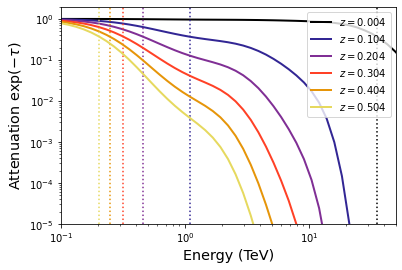
For each redshift, calculate the energy where \(\tau = 1\):
[5]:
Etau1GeV = []
for i,zz in enumerate(z):
    Etau1GeV.append(tau.opt_depth_inverse(zz,1.))
Calculate the attenuation:
[6]:
atten = np.exp(-1. * tau.opt_depth(z,ETeV))
Do the plot
[7]:
for i,zz in enumerate(z):
    plt.loglog(ETeV,atten[i],
              ls = '-', color = plt.cm.CMRmap(i / float(len(z))),
              label = '$z = {0:.3f}$'.format(zz), lw = 2)
    plt.axvline(Etau1GeV[i] / 1e3, ls=':', color = plt.cm.CMRmap(i / float(len(z))) )

plt.gca().set_ylim((1e-5,2.))
plt.gca().set_xlim((1e-1,5e1))
plt.gca().set_xlabel('Energy (TeV)',size = 'x-large')
plt.gca().set_ylabel(r'Attenuation $\exp(-\tau)$',size = 'x-large')
plt.legend(loc = 'upper right')
[7]:
<matplotlib.legend.Legend at 0x12553f760>
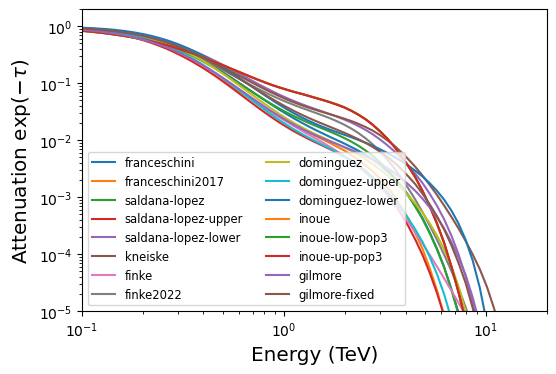
Compare models
[8]:
tau = {}
for m in OptDepth.get_models():
    tau[m] = OptDepth.readmodel(m)
[9]:
plt.figure(dpi=100)

ETeV = np.logspace(-2, 1.5,100)
z = 0.3


for m, t in tau.items():
    plt.loglog(ETeV, np.exp(-t.opt_depth(z, ETeV)), label=f"{m}")

plt.gca().set_ylim((1e-5,2.))
plt.gca().set_xlim((1e-1,2e1))
plt.gca().set_xlabel('Energy (TeV)',size = 'x-large')
plt.gca().set_ylabel(r'Attenuation $\exp(-\tau)$',size = 'x-large')
plt.legend(loc='lower left', ncol=2, fontsize='small')
[9]:
<matplotlib.legend.Legend at 0x1260ef880>